Guangzhou, China
Import and Export Commodity Trading Exhibition Hall Zone B
Date: November 18-20, 2026


The global corrugated paper packaging market is estimated to be $224.6 billion by 2025. According to the latest report released by Global Market Insights Inc., the market is expected to grow from $234.3 billion in 2026 to $313.7 billion in 2035, with a compound annual growth rate of 3.3%.
Key points of corrugated paper packaging market
Market size and growth
Market size in 2024: $233.8 billion
Market size forecast for 2034: 380 billion US dollars
Compound annual growth rate from 2025 to 2034: 5%
Main market driving factors
The expansion of global e-commerce.
The continuous advancement of packaging technology.
The demand for food and beverage industry is growing.
Challenge
Sustainable development issues.
Competition from alternative packaging such as flexible packaging and plastic.
The rapid expansion of global e-commerce platforms such as Amazon, Alibaba, and Flipkart has greatly increased the demand for corrugated paper packaging. The growth of subscription boxes, such as beauty sets or selected snacks, further drives the demand for customized and attractive corrugated paper packaging to enhance the unpacking experience. With the growth of online order volume, manufacturers are producing more diverse carton specifications, cushioning pads, and precision sized packaging solutions to reduce waste and lower transportation costs.
End of pipe delivery increases the complexity of packaging, requiring it to withstand frequent handling and various weather conditions. For e-commerce goods that may pass through multiple distribution centers, corrugated cardboard boxes with reinforced edges, tear resistant design, and high-quality printability are becoming essential. For example, brands such as IKEA and Wal Mart have adopted a stronger corrugated box design to reduce the damage rate during fast door-to-door delivery. Innovation is also accelerating, and companies are deploying AI driven design tools to create efficient and impact resistant packaging specifications for end of pipe logistics.
The increasing awareness of environmental protection and regulatory actions are driving brands to shift towards sustainable alternative solutions, bringing significant competitive advantages to corrugated paper packaging. Many countries have implemented bans or restrictions on disposable plastics, such as the European Union《Disposable Plastic Directive》The nationwide plastic ban in India has forced businesses to shift towards recyclable and biodegradable materials. Corrugated paper packaging, mainly made of renewable fibers and widely recycled, has become the preferred choice for environmentally friendly brands in the food, cosmetics, and retail sectors. Companies such as Nestle and Unilever are gradually shifting their packaging portfolios towards corrugated paper solutions to fulfill their sustainability commitments.
The brand also uses corrugated paper design to replace plastic for secondary packaging and transportation packaging. For example, Coca Cola andDiageoWe are using corrugated fiberboard transport trays instead of plastic shrink wrap for multi packaging of beverages. Similarly, retailers such as TESCO Group and Target are turning to corrugated shelf ready packaging to reduce plastic use and improve recyclability. These changes, coupled with consumers' increasing expectations for eco-friendly packaging, are driving innovative strides in lightweight corrugated materials, water-based coatings, and closed-loop recycling solutions.
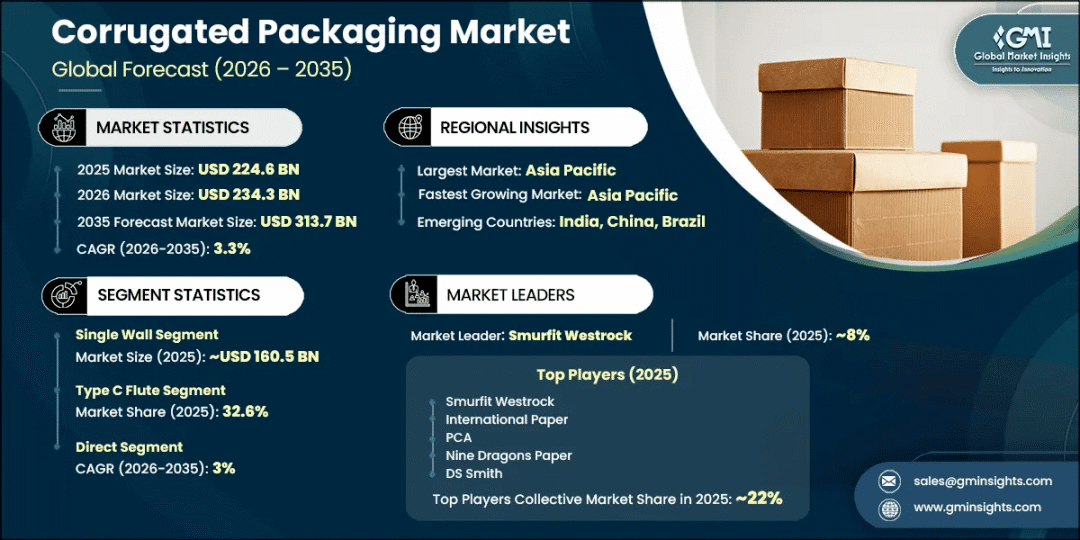
The rapid expansion of e-commerce has made it the dominant factor driving demand for corrugated paper packaging, occupying an important share of global production.international paper Leading manufacturers such as Amazon, IKEA and Wal Mart are innovating to meet the needs of e-commerce giants such as Amazon, IKEA and Wal Mart. These enterprises adopt advanced corrugated cardboard box specifications and utilize AI driven precision sizing technology to optimize packaging, reduce waste, and minimize damage during the final delivery process. According to the Fiber Box Association, the demand for e-commerce packaging has grown by over 20% in the past five years, and corrugated cardboard boxes play a key role in ensuring product safety and sustainability. With the expansion of online retail globally, especially in emerging markets, this trend is expected to continue. Corrugated Packaging Being at the forefront of sustainable development, according to a report by the European Paper Industry Federation (CEPI), its global recycling rate exceeds 90%. Major manufacturers including DS Smith and Mondi are leading the trend of replacing disposable plastics with fiber based alternatives. In Europe, brands such as Coca Cola and Diageo have adoptedcorrugated fiberboard Transport packaging is used to replace plastic shrink wrap to comply with regulatory frameworks such as the EU Packaging and Packaging Waste Regulations. The corrugated packaging industry is undergoing significant consolidation, with manufacturers expanding their market share and production capacity through mergers and acquisitions. Smurfit Kappa and WestRock are actively promoting mergers and acquisitions to enhance operational scale and efficiency. In addition, capacity expansion plans are being promoted in demand growing regions such as Asia Pacific and Latin America. Digital printing is reshaping the corrugated packaging industry, enabling on-demand high-resolution brand customization. FEFCO members and manufacturers such as converters are investing heavily in digital and hybrid printing technologies to meet the growing demand for customized packaging solutions. This trend is particularly prominent in the e-commerce and retail sectors, where brands enhance customer engagement through personalized packaging. Digital printing also supports short version production, shortening delivery time and reducing waste, while maintaining high-quality output. Lightweight has become a key direction for manufacturers to reduce costs and enhance sustainability. Companies such as Mondi and International Paper are developing thinner and lighter corrugated materials (such as E-type) to optimize transportation efficiency without compromising product protection. These innovations are particularly important in the food and beverage industry, which accounts for nearly half of the demand for corrugated packaging. The corrugated packaging industry is at the forefront of circular economy practices, with an average recycling rate of nearly 90% for corrugated packaging in Europe according to the FEFCO report. Manufacturers such as DS Smith and Smurfit Kappa are implementing closed-loop recycling systems to maximize resource efficiency and minimize waste. Environmental organizations point out that using recycled corrugated materials can reduce greenhouse gas emissions by 70% compared to virgin fibers. These efforts are consistent with global sustainable development goals and regulatory requirements, making corrugated packaging the preferred choice for environmentally friendly brands and consumers. According to wall thickness classification, the corrugated packaging market is divided into single-layer, double-layer, and three-layer. The revenue of the single-layer segmented market is expected to reach approximately 160.5 billion US dollars in 2025, and is projected to grow at a compound annual growth rate of 3% from 2026 to 2035. Single layer corrugated cardboard dominates the corrugated packaging industry with its optimal balance of strength, cost-effectiveness, and material usage. The single-layer structure consists of one layer of corrugated core paper and two layers of backing paper, which can provide sufficient compressive strength and cushioning protection for a wide range of applications such as food and beverage, fast-moving consumer goods, e-commerce, and consumer durable goods. For most secondary and tertiary packaging requirements, single-layer paper boxes avoid the additional weight and cost of double-layer or three-layer alternatives while meeting performance requirements. In addition, sustainable development factors further consolidate the dominant position of single-layer corrugated packaging. Compared with multi-layer corrugated cardboard, single-layer corrugated packaging has lower fiber usage, which can reduce raw material consumption, energy consumption, and transportation emissions. With the increasing emphasis on lightweight and recyclability by brand owners and regulatory agencies, single-layer corrugated packaging forms are highly compatible with circular economy goals, while maintaining scalability and production efficiency in high-yield packaging production. Divided by corrugated type, the corrugated packaging market mainly includes A-type corrugated, B-type corrugated, C-type corrugated, E-type corrugated, and F-type corrugated. Among them, the C-type corrugated subdivision market will dominate in 2025, with a market share of 32.6%. C-type corrugated holds a dominant position in the corrugated packaging industry, as it achieves a balance between stacking strength, cushioning performance, and printability that meets industry standards. With a medium corrugated height and approximately 39-43 corrugations per foot, C-type corrugations have reliable edge compression strength and vertical compression strength, making them suitable for transportation, warehousing, and palletizing distribution. This versatility makes it the preferred choice for multiple terminal application industries. In addition, C-type corrugated supports efficient processing conversion and high-quality graphic printing, which is increasingly important for brand communication and retail ready packaging. It performs excellently in flexographic printing and digital printing processes, enabling manufacturers to meet both functional and aesthetic requirements simultaneously. Its widespread acceptance in the global supply chain further consolidates its dominant position, and standardization simplifies procurement, production planning, and logistics processes. Divided by distribution channels, the corrugated packaging market includes two models: direct sales and indirect sales. Direct sales channels dominate and are expected to grow at a compound annual growth rate of 3% from 2026 to 2035. Direct sales channels dominate the corrugated packaging industry as large end customers increasingly prefer to purchase packaging directly from manufacturers. This channel helps to better control prices, customized services, and supply chain reliability, especially suitable for bulk purchasers such as e-commerce, food processors, and consumer goods manufacturers. Direct cooperation enables packaging manufacturers to collaborate deeply with customers, jointly optimizing packaging design, material usage, and performance testing. In addition, direct sales channels support on-time delivery models and long-term supply contracts, which are crucial for managing demand fluctuations and reducing inventory costs. Corrugated packaging manufacturers benefit from stronger customer stickiness and improved demand forecasting, while buyers receive faster delivery cycles and more consistent quality assurance. The United States dominates the entire North American market, with a market value of $38.8 billion by 2025, expected to grow at a compound annual growth rate of 3.6% between 2026 and 2035. The United States is one of the most mature and technologically advanced markets in the world. The demand is mainly driven by the e-commerce, food and beverage, and consumer goods industries, with corrugated cardboard boxes playing a key role in secondary and tertiary packaging. The high penetration rate of manufacturing automation, warehouse grade packaging design, and standardized carton specifications have jointly improved the efficiency and scalability of various industries. Sustainable development initiatives, including weight reduction design and increased use of recycled materials, are also reshaping product development trends in the US market. In addition, the dominant position of large integrated enterprises and long-term supply contracts with major retailers and e-commerce platforms have supported the stable growth of the market. The emphasis on recyclable and fiber based packaging in regulatory policies has further promoted the adoption of corrugated packaging. Innovative solutions such as intelligent packaging, high-quality digital printing, and customized cardboard boxes are increasingly being applied to meet brand marketing and logistics optimization needs, consolidating the leading position in the US market. In the European market, Germany is expected to achieve significant and promising growth between 2026 and 2035. The European corrugated packaging industry is characterized by strong regulatory frameworks that promote sustainable development, recycling, and circular economy practices. Corrugated packaging is widely used in the fields of food, beverage, pharmaceutical, and industrial products due to its high recyclability and compliance with strict environmental regulations. Western Europe, with its well-established retail organization, cross-border trade, and advanced logistics infrastructure, has a particularly considerable consumption volume. In addition, the demand for lightweight and high-performance corrugated packaging in the European market continues to grow, which can effectively reduce material usage while maintaining strength. Manufacturers are increasingly investing in energy-saving production technologies and water-based inks to meet carbon reduction targets. The demand for shelf ready and retail ready packaging in the region is also increasing, especially in the fast-moving consumer goods sector, further driving the market's sustained growth. In the Asia Pacific market, China is expected to occupy 32.5% of the market share by 2025 and is expected to grow at a compound annual growth rate of 3.8% between 2026 and 2035. The Asia Pacific region is the fastest-growing area in the corrugated packaging industry, mainly driven by the acceleration of industrialization and urbanization processes, as well as the expansion of e-commerce platforms. China, India, Japan, and Southeast Asian countries have seen a continuous increase in demand for corrugated packaging due to the growing consumption of packaged food, electronic products, and daily necessities. Corrugated packaging is widely used for transportation and distribution in fragmented and high-capacity logistics networks. In addition, the rise of organized retail and the expansion of export-oriented manufacturing are driving the adoption of standardized corrugated packaging formats. Despite the high cost sensitivity of emerging economies, the increasing awareness of sustainable packaging and government restrictions on plastic use are accelerating the shift towards paper-based packaging solutions. In the Middle East and African markets, Saudi Arabia is expected to achieve significant and promising growth between 2026 and 2035. The corrugated packaging industry in the Middle East and Africa is still in the development stage, with growth mainly driven by the expansion of the food and beverage, agriculture, and consumer goods industries. The rapid population growth, urbanization process, and improvement of retail infrastructure, especially in Gulf Cooperation Council countries, are increasing the demand for corrugated cardboard boxes in packaging, storage, and transportation. Corrugated packaging is highly favored due to its ability to withstand long-distance transportation and harsh weather conditions. In Africa, growth benefits from an increase in agricultural exports and an increase in the penetration rate of packaged goods; In the Middle East, import driven economies and logistics hubs provide assistance for market development. Although the market is facing challenges such as limited recycling infrastructure in some regions, investments in local manufacturing capabilities and sustainable development initiatives are gradually driving adoption rates. With the modernization of the supply chain, corrugated packaging is expected to play a greater role in the Middle East and Africa region. Article reposted from: ACCA Asia Pacific AllianceMarket Trends in Corrugated Paper Packaging
Analysis of the Corrugated Packaging Market
North American Corrugated Packaging Market
The European Corrugated Packaging Market
Corrugated Packaging Market in the Asia Pacific Region
Middle East and Africa Corrugated Packaging Market
Contact Us
- Address:Room 904, Greenland Center, Financial City, No. 662 Huangpu Avenue Middle, Tianhe District, Guangzhou City
- Phone:020-89300178/89300188
- Email:gzboya@vip.163.com
email subscription
- Click to subscribe to email now (industry news, exhibitor updates, etc.)
- submit
- I want to visit | Be an exhibitor | Cloud exhibition | Events
Follow us